AI Piano Lesson Software vs. Traditional Lessons: The Definitive Comparison
Should you learn piano with a traditional teacher or an AI app? It sounds like a simple question, but most comparisons you'll find online miss the point entirely — they compare price and convenience without asking whether either method will actually teach you to play. This page cuts through that.
The real question isn't "human vs. software." It's whether your chosen method delivers Real-Time Pedagogy — the kind of active, responsive teaching that corrects your mistakes in the moment, guides you through them systematically, and builds genuine skill rather than surface familiarity. That standard is what separates methods that produce real pianists from methods that don't.

The Three Categories of Modern Piano Learning
To make a meaningful comparison, it helps to understand that piano learning today falls into three fundamentally different categories — and only one of them is a genuine AI Expert System. The other two are far more common, and far more often mistaken for something they're not.
1. The Traditional Teacher (In-Person or Online)
The traditional human teacher has long been the gold standard for one reason: genuine pedagogical depth. A skilled teacher observes your playing, identifies the root cause of each mistake, prioritises which issues to address first, and guides you through a structured correction process. That real-time feedback loop is what produces real progress.
The limitations are equally well known. Traditional lessons are expensive ($30–$100+ per hour), scheduled once a week, and leave students practising alone for the other 167 hours — often reinforcing the very mistakes that will need to be un-learned at the next lesson. The teaching is excellent; the access is limited.
2. Static Video and Game-Based Apps
YouTube tutorials, falling-note apps, and MIDI-matching games are widely used and widely misunderstood. These tools can show you which notes to press, but they cannot tell you why you're struggling or guide you through fixing it. They detect surface errors but don't reason about them. Because they lack genuine inference, the feedback they produce is shallow — and shallow feedback leads to shallow learning.
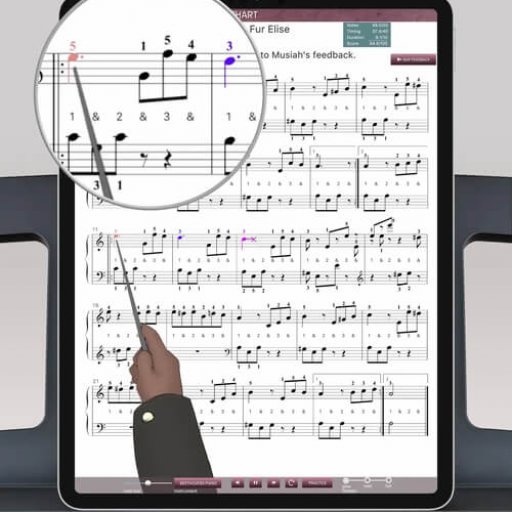
A specific example: most apps assess pitch and basic timing, but not duration — how long each note is held. Musiah assesses all three, with a sophisticated millisecond-accurate timing algorithm that distinguishes between notes played within a primary tolerance, a wider tolerance, and genuinely incorrect timing. That precision matters enormously over time. Students using apps that skip duration assessment often develop subtle errors that go unflagged for months — and arrive at Musiah needing to unlearn them.
3. The AI Expert System
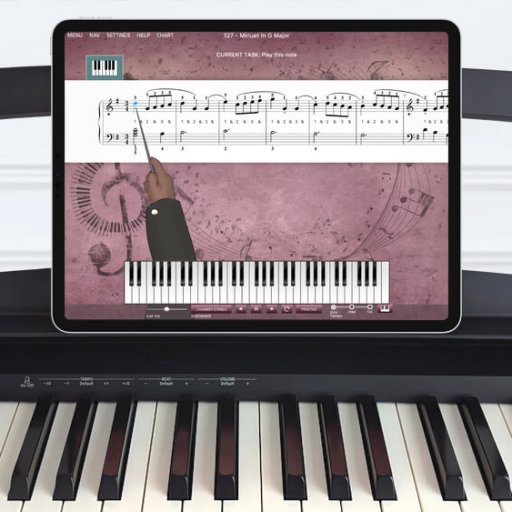
A genuine AI Expert System is a different category entirely. This approach — developed by Brendan Hogan over a four-year period and first launched in 2012 — uses a branch of artificial intelligence specifically designed to emulate the decision-making of a human expert. Musiah doesn't just detect errors — it reasons about them. It identifies patterns across your mistakes, decides which issues matter most, and guides you through a correction process that mirrors what a skilled human teacher would do.
This is what makes it possible for Musiah to deliver Real-Time Pedagogy 24 hours a day, at a fraction of the cost of private lessons — not because it approximates teaching, but because it genuinely replicates the depth of it.
Comparison: At a Glance
Applying the Real-Time Pedagogy standard to all three categories produces a clear picture:
| Feature | Traditional Teacher | Video / Game Apps | Musiah (AI Expert System) |
|---|---|---|---|
| Real-Time Pedagogy | During lessons only | No | Yes — 24/7 |
| Reasons About Mistakes | Yes | No (detects only) | Yes |
| Note Duration Assessment | Yes | No | Yes — every note |
| Mastery-Gating | Yes (good teachers) | No | Yes |
| Structured Syllabus | Varies | No (song library) | Yes — 13 levels |
| 24/7 Availability | No | Yes | Yes |
| Cost | High ($$$) | Low ($) | Affordable ($$) |
| Proven Track Record | Varies by teacher | Limited | 18 years / 80,000 students |
Will AI Replace Human Piano Teachers?
This is a fair question, and it deserves an honest answer rather than a diplomatic one.
For the vast majority of learners — beginners and intermediate students working toward genuine competence — a well-designed AI Expert System delivers everything a human teacher delivers, and removes the constraints that make traditional lessons inaccessible for most people. The scheduling friction, the weekly cost, the hour between lessons where mistakes go uncorrected: Musiah eliminates all of that.
Musiah was built on a teaching method developed with 80,000 students and 800 teachers over 18 years before the software was written. That's not a marketing claim — it's the reason the method works. No other piano learning software can point to that kind of real-world validation. The result is that Musiah students complete the equivalent of a 5–6 year traditional syllabus in 18 to 26 weeks — you can see the data.
Where human teachers retain a genuine edge is at the advanced performance level — nuance, interpretation, stage presence, the refinements that separate a technically accomplished player from an artist. For students pursuing that level, a human teacher remains valuable. For the overwhelming majority who want to learn piano properly, play real music, and actually get there, Musiah is the more effective path.
As Musiah's founder Brendan Hogan puts it: the phase where most students give up isn't the advanced phase. It's the early-to-intermediate phase, where mistakes go uncorrected, progress stalls, and the gap between effort and result becomes discouraging. That is precisely the phase where an AI piano teacher that never tires, never judges, and is always available makes the decisive difference.
Frequently Asked Questions
The questions people ask most often when comparing piano lesson software with traditional lessons:
Q: Is AI piano software as good as a real teacher?
For beginners through to advanced-intermediate level, a genuine AI Expert System matches or exceeds what a human teacher delivers — and removes the constraints of scheduled lessons and hourly costs. The key distinction is between a true AI Expert System (which reasons about your performance) and a game-based or video app (which only detects surface errors). Musiah is the former. Most popular apps are the latter.
Q: What is the main advantage of traditional piano lessons over software?
The honest answer is access to a teacher's full range of human judgment — particularly at the advanced performance level, where nuance, artistic interpretation, and stage coaching matter. For beginners and intermediate students focused on building genuine technique and reading ability, a well-designed AI Expert System delivers equivalent pedagogical depth with far greater accessibility.
Q: Can you really learn piano properly with an app?
With most apps, no — because most apps don't provide genuine instruction. They provide note detection and visual cues, which is different. With a true AI Expert System like Musiah, yes. The method was tested with 80,000 students over 18 years before being built into software. Students complete a full 13-level syllabus — covering everything a traditional teacher would cover — in 18 to 26 weeks.
Q: What should I look for in piano lesson software?
Four criteria matter above all others. First, note duration assessment — most apps assess pitch and basic timing, but not how long each note is held. Musiah assesses all three with millisecond accuracy. Second, mastery-gating — the requirement to genuinely learn each piece before advancing. Third, a structured syllabus rather than a song library. Fourth, real-time feedback that guides correction rather than just flagging errors. An app that passes all four is rare. Musiah passes all four. For a full breakdown, see what makes the best piano learning app.
Q: Is Musiah suitable for complete beginners?
Yes — Musiah is designed specifically for true beginners and restart-from-scratch students. The syllabus begins from the very first note and builds systematically through 13 levels. No prior musical knowledge is needed. The beginner piano lessons for adults and beginner piano lessons for kids pages have full details for each audience.
Q: How much does Musiah cost compared to traditional lessons?
Traditional private lessons typically run $30–$100+ per hour, once a week — $120–$400+ per month for a single weekly lesson. Musiah costs a fraction of that, includes up to 6 family members at no extra cost, and comes with a 14-day free trial. See the pricing page for current rates.
Ready to Experience the Difference?
Choose the path that fits your goals and start learning with the world's most proven AI piano teaching method.
Adult Beginners
A full 13-level curriculum built for the adult brain — structured, fast, and genuinely taught by AI.
Start Adult LessonsKids (Ages 7+)
An epic musical adventure that turns real piano skills into a quest your child will actually want to practice.
Start Kids LessonsAlready Play?
Import your own scores and get note-level AI feedback to master complex repertoire faster.
Explore Practice Tools