The Benefits of Learning Piano as an Adult — More Than You Might Expect
Most articles about the benefits of learning piano list the same bullet points. Better memory. Reduced stress. Improved coordination. A sense of achievement. All true — and all worth having. But they barely scratch the surface of what actually happens to an adult brain that takes on a serious musical instrument.
This article goes deeper. After more than 40 years of teaching piano and 18 years of developing the Musiah method, I've watched the benefits of piano learning unfold in adult students in ways that standard lists don't capture. Some of what I'll share here you won't find anywhere else.
The Dementia Prevention Benefit — Backed by Research
For many adults, especially those in their 50s, 60s, and beyond, cognitive health is the most compelling reason to start learning piano. And the research here is genuinely striking.
A landmark 2014 twin study published in the International Journal of Alzheimer's Disease found that older adults who played a musical instrument were 64% less likely to develop dementia or cognitive impairment than their non-playing twin siblings. Because the study compared identical and fraternal twins, it controlled for genetics by design — strengthening the case that it is playing music itself, rather than any pre-existing advantage, that contributes to cognitive resilience.
This isn't a study about passive music listening. It's about active playing — the kind of demanding, multi-layered cognitive engagement that learning piano requires. Reading sheet music, coordinating both hands independently, tracking timing, listening critically to your own playing — all simultaneously. This is precisely the kind of brain workout that researchers believe contributes to cognitive reserve: the brain's capacity to maintain function even as it ages.
It's also worth noting that this benefit is available at any age. You don't need to have started as a child. The brain retains neuroplasticity throughout adulthood — the capacity to form new neural connections — and learning a complex new skill like piano actively develops it.
The Neuroplasticity Workout — Why Piano is Uniquely Demanding
Not all hobbies exercise the brain equally. Playing piano is unusual in the range of cognitive functions it engages simultaneously:
Reading Music While Playing
Reading standard music notation requires your brain to rapidly decode symbols, translate them into specific finger movements, and execute them in real time — all while staying ahead of where you currently are in the score. This is a form of sustained, high-speed pattern recognition that few other activities match.
Two-Hand Independence
Each hand plays different notes, often in different rhythms, at the same time. In the early stages this feels almost impossible — and that's the point. Training the brain to coordinate two independently moving systems is genuinely challenging, and that challenge is where much of the cognitive benefit lies.
Memory Training
Learning pieces by memory, internalising fingering patterns, and recalling musical structures all actively strengthen both short-term working memory and long-term memory pathways. Many adult students report noticeable improvements in everyday memory as a direct result of regular piano practice.
Listening and Self-Correcting
Unlike passive entertainment, piano practice requires constant critical listening — assessing what you just played, comparing it to what you intended, and adjusting in real time. This trains a form of focused, evaluative attention that transfers to many other areas of life.
Emotional Expression
Music is one of the most direct channels for emotional expression available to human beings. For many adults, this aspect of piano learning becomes one of the most valued — a private space for processing feelings that don't have easy words.
The Rarest Benefit: Split Concentration
This is the benefit that almost no one talks about — and in my view, the most remarkable thing that piano learning does to a mind.
I first became aware of it as a young student learning Chopin's first Nocturne in B flat minor. What is unusual about this piece is that for every six or twelve notes played by the left hand, the right hand moves in independent patterns of seven, eleven, twenty, and twenty-two notes.
To play a piece like this, you cannot simply coordinate the two hands step by step in the usual fashion. After learning each hand separately, you must enter what I can only describe as a Zen-like state of "no mind" — where each hand, though playing something utterly different from the other, operates in perfect coordination. Neither hand dominates your attention. Both simply happen.
This is the development of split concentration — the ability to hold multiple streams of complex activity in awareness simultaneously, without any one stream overwhelming the others. And it develops long before you reach the level of Chopin. It begins with the very first pieces that require true two-hand independence.
What Split Concentration Actually Looks Like
Consider a concert pianist playing what appears to be a simple sequence of chords. Why do they look so intensely concentrated? Because they are not merely playing chords. In their mind, each chord is being heard as four simultaneous melody lines — Soprano, Alto, Tenor, and Bass — each with its own shape, its own trajectory, its own musical logic. They are following and shaping all four melodies at once.
Another dimension: experienced pianists learn to listen to their playing from two perspectives simultaneously — close up, as someone in the front row of a concert hall would hear it, and far away, as someone at the back would hear it. The two perspectives require different kinds of attention, and a skilled pianist holds both at once.
These are not tricks or special talents. They are skills — developed through years of piano practice — and they belong to anyone who commits to learning piano properly.
A Personal Illustration
Some years ago I was performing at a charity dinner. My piece was Chopin's Étude in C minor Op. 10, No. 12 — the "Revolutionary" Étude — technically demanding, intensely emotional. Just as I was about to begin, a woman at the back of the room began talking loudly to her friend and continued even as the rest of the audience turned to look at her.
From the stage, I fixed my gaze on her and began to play — without once looking at the keyboard, without once taking my eyes off her, from start to finish. My attention was fully on her and fully on the music simultaneously.
A well-known priest who witnessed the performance remarked afterwards that it was "the most incredible display of split concentration I have ever seen."
Granted, I was showing off — perhaps it was the arrogance of youth — but I did it to make a point, and because I could, thanks to the training I had received through years of piano lessons.
I share this not to boast — but to illustrate concretely what piano training makes possible. I could do it not because of any special gift, but because of what years of piano learning had developed in me. The same capacity develops, in proportion to their level, in every student who learns piano properly.
The Practical Benefits — Real Life, Measurable
Beyond the neurological and the profound, piano learning delivers a set of practical benefits that adult students consistently report:
Stress Relief and Mental Decompression
Piano practice requires a quality of focused attention that effectively displaces everyday anxiety. Many adult students describe their practice sessions as the one part of their day when they are completely present — not thinking about work, relationships, or the news. The focused engagement demanded by the instrument is, paradoxically, a form of rest.
A Lifelong Skill With No Ceiling
Unlike many hobbies, piano has no point of completion. There is always more to learn, always a more demanding piece, always a deeper level of musical understanding available. This makes it one of the few activities that can occupy and challenge an adult mind indefinitely — for decades, if desired.
Self-Discipline and Incremental Progress
Learning piano teaches the adult brain something it often needs reminding of: that consistent small efforts compound into large results over time. The experience of working on a difficult passage for a week and then suddenly playing it cleanly is one of the most satisfying experiences available to an adult learner — and one that builds a transferable mindset.
Social Dimension
The ability to play piano opens doors — to playing for family and friends, to participating in musical communities, to sharing something personally meaningful with others. Many adult students describe this as an unexpected source of connection and joy.
How Musiah Specifically Maximizes These Cognitive Benefits
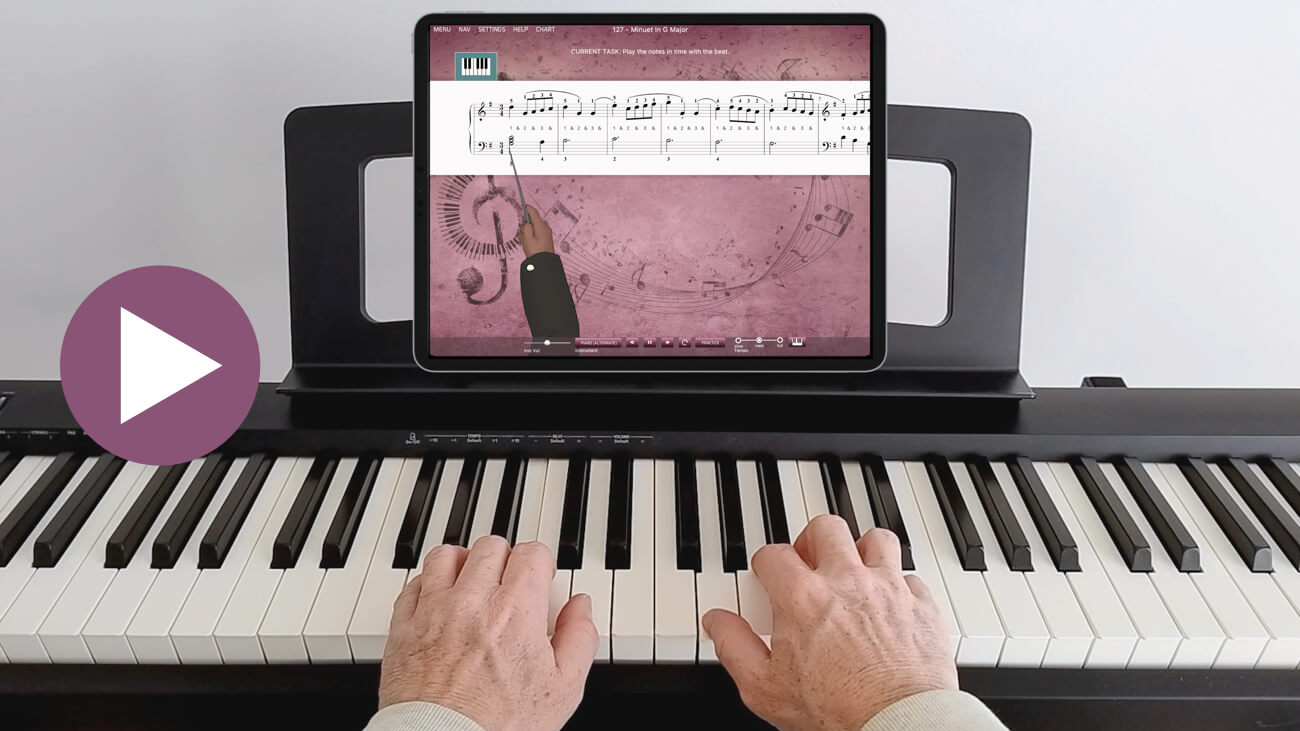
While any serious piano learning delivers cognitive benefits, the way a student is taught makes a significant difference to how quickly and deeply those benefits develop. The Musiah syllabus was specifically designed — through 18 years of refinement with over 80,000 students — to maximize cognitive gains from the very first lesson.
The Fixed Hand Position Strategy
Most piano courses move students' hands around the keyboard early on, introducing new positions before the fundamentals are secure. Musiah takes a different approach: in the early stages, both hands remain in one position — the C position — for an extended period. This isn't a limitation; it's a deliberate cognitive strategy.
By staying in one position, adult students develop deep familiarity with the notes covered by each hand before adding the complexity of lateral movement. The result is that when new positions are eventually introduced, the transition is smooth and intuitive — because the underlying mental mapping is already solid.
Advanced Coordination Challenges From the Start
Because the note range is fixed, Musiah can challenge students' coordination within that range to a much greater extent than traditional courses attempt. Adult beginners — who often underestimate how quickly they can progress when the method is right — find themselves developing genuine two-hand independence from their very first songs.
Coordination skills that Musiah students develop within their first few pieces include:
- Playing both hands together from the outset
- Ensemble playing — coordinating with a separate musical part
- Moving the thumb independently while keeping the hand in position
- Dotted rhythms and pairs of quavers
- Playing in thirds — two notes within one hand simultaneously
- Syncopation and other complex rhythmic coordination challenges
In a traditional piano course, most of these skills appear only after months or years of study. In Musiah, they are introduced systematically from the beginning — not to overwhelm students, but because the fixed hand position makes it entirely achievable, and because this level of challenge is precisely what drives the deeper cognitive benefits described above.
The Result: Effortless Mastery of the Full Keyboard
When Musiah students eventually move to new hand positions — which the full 13-level syllabus of course covers comprehensively — they do so having already developed the mental mapping, coordination, and reading fluency that makes the transition feel natural rather than daunting. They have, in a sense, already done the hardest cognitive work. Everything that follows builds on a genuinely solid foundation.
This is why the cognitive benefits of learning with Musiah aren't theoretical — they're built into the structure of the course itself, from the very first lesson.
Thanks for reading,
Brendan Hogan L.Mus.A., A.Mus.A.
Piano Teacher & Musiah Inventor
Frequently Asked Questions
The questions adults ask most often about the benefits of learning piano:
Q: What are the cognitive benefits of learning piano as an adult?
Learning piano engages multiple cognitive systems simultaneously — reading music notation, coordinating two hands independently, tracking rhythm, and listening critically to your own playing. This multi-layered engagement actively develops memory, focus, fine motor coordination, and neuroplasticity. Over time, it also develops what I call split concentration — the ability to hold multiple streams of complex activity in awareness at once — which is one of the most remarkable things piano learning does to a mind.
Q: Can learning piano help prevent dementia?
Research suggests a meaningful connection. A 2014 twin study published in the International Journal of Alzheimer's Disease found that older adults who played a musical instrument were 64% less likely to develop dementia or cognitive impairment than their non-playing twin. Because the study compared twins, it controlled for genetics — strengthening the case that active music-making itself contributes to cognitive resilience.
Q: Is it too late to get cognitive benefits from learning piano as an adult?
No. The brain retains neuroplasticity throughout adulthood — the capacity to form new neural connections — and learning a complex new skill actively develops it regardless of age. Many of Musiah's most cognitively engaged students are in their 60s, 70s, and 80s. For more on this, see our guide to learning piano as an adult.
Q: Does learning piano reduce stress?
Many adult students report that piano practice is the one part of their day when they are completely present — not thinking about work or everyday concerns. The focused attention that playing requires effectively displaces anxiety. This isn't passive relaxation; it's active engagement that occupies the mind so fully that stress simply has no room.
Q: How long does it take to experience the benefits of learning piano?
Some benefits — the sense of focus, the satisfaction of incremental progress — are felt almost immediately. The deeper cognitive benefits, including the development of two-hand independence and the early stages of split concentration, typically emerge within the first few months of consistent practice. With Musiah's beginner piano lessons for adults, students are playing real pieces with both hands within their first few lessons — which means the cognitive engagement starts from day one.
Q: Do I need to reach an advanced level to benefit from learning piano?
No. The cognitive demands of piano begin with the very first lessons — reading notation, coordinating both hands, listening critically. These demands don't wait for advanced repertoire. In fact, the early stages of learning, when everything is new and the brain is forming entirely new pathways, may be among the most cognitively active periods of the entire learning journey.
Experience the Benefits for Yourself
Start your free 14-day trial and discover what consistent piano learning does for your mind, your focus, and your enjoyment of life.
Adult Beginners
A full 13-level curriculum built for adults — structured, fast, and genuinely taught by AI.
Start Adult LessonsKids (Ages 7+)
An epic musical adventure that turns real piano skills into a quest your child will actually want to practice.
Start Kids LessonsAlready Play?
Import your own scores and get note-level AI feedback to master complex repertoire faster.
Explore Practice Tools